If you run a small shop in India, you do not need to spend weeks learning website design or pay a developer a large upfront amount just to get your products online.
Apnaweb gives Indian businesses a simple way to start. You can build your website for free, use AI to generate the first version or choose a ready-made template, edit the content yourself, add WhatsApp enquiries, and publish when you are ready. Apnaweb currently offers publishing from ₹99 for three months and ₹299 for a year, depending on the plan.
But is it the right choice for every online store?
Not necessarily. Shopify, WooCommerce, Wix and other platforms can make sense for businesses with different requirements. The important thing is to compare them based on how you actually sell, not just the number of features listed on their websites.
Quick answer: What is the best option for an Indian online store?
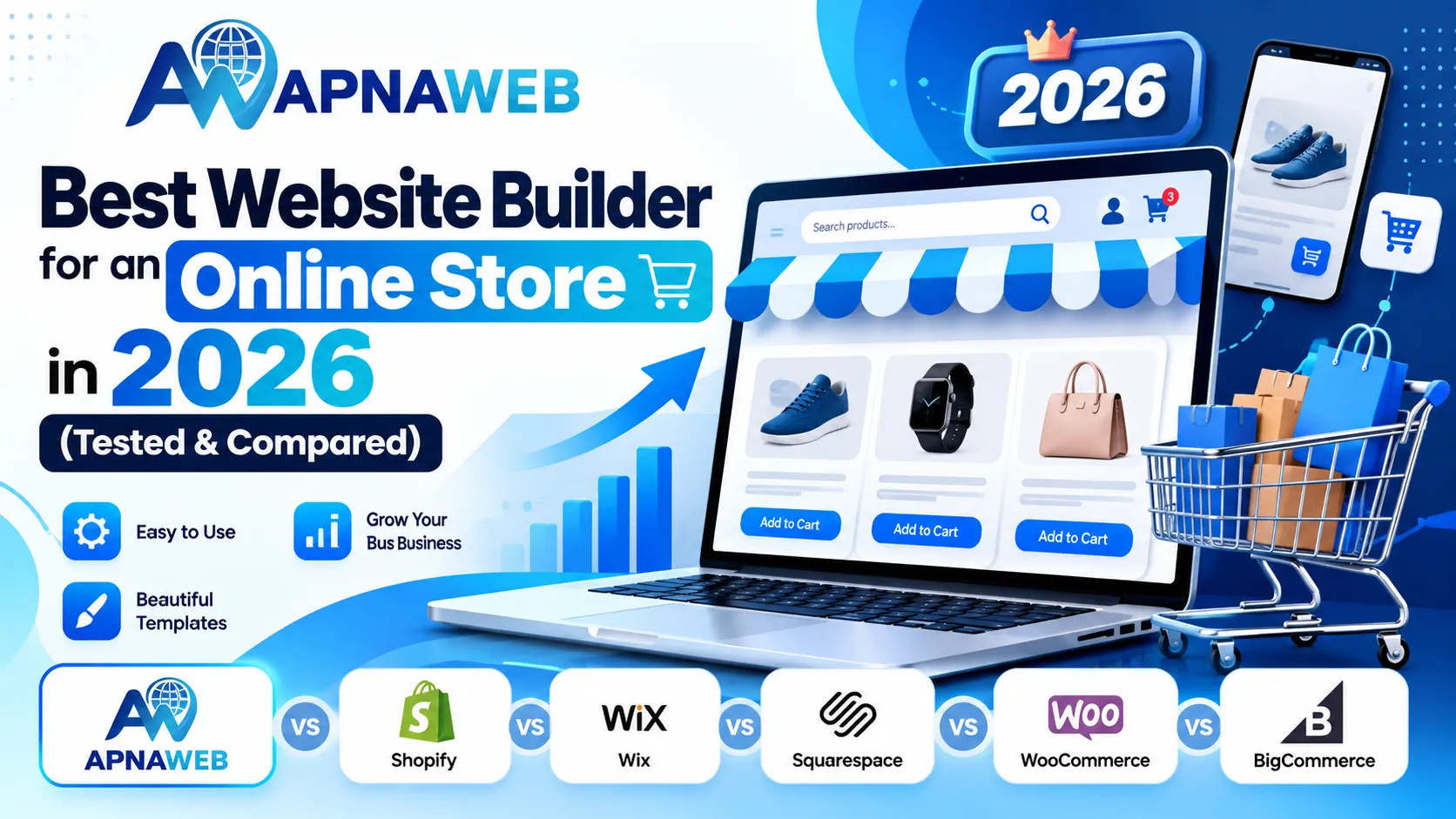
Current 2026 comparison guides commonly highlight Shopify for larger or growing ecommerce operations, WooCommerce for WordPress users who want control, and Wix for businesses that prioritise visual design.
The better question is therefore not simply “Which builder is number one?”
It is: Which builder fits the way your shop sells?
What we compared
Instead of looking only at monthly subscription prices, compare a website builder on these points:
- How quickly can you launch?
- Can you edit the website without a developer?
- Does it work properly on mobile?
- Can customers contact you through WhatsApp?
- Can you use your own business URL?
- What does it really cost to publish?
- Can you add your products and services easily?
- Does it give you basic SEO control?
- Is it practical for Indian customers?
- Can you change the website as your business grows?
This last point is often ignored.
A builder may look cheap when you first sign up, but if every small change requires a developer or an expensive add-on, the real cost becomes much higher.
Apnaweb: A practical option for small Indian stores
Apnaweb is built around small and local businesses in India rather than assuming every customer is a large ecommerce brand.
You can either describe your business to the AI website generator or start with a ready-made design. The AI option can generate a complete business website in under a minute, while templates let you control the layout yourself. Both can be edited visually without coding.
For a shop owner, this means you can create website for shop online without first learning HTML, CSS or complicated website software.
The platform also includes a WhatsApp enquiry option and an enquiry dashboard. That matters in India because many customers prefer asking about price, availability, size, colour or delivery before placing an order.
Apnaweb also provides mobile-first layouts and a custom business URL, so your website can be shared through Google, WhatsApp, Instagram, visiting cards and other channels.
What about Shopify?
Shopify is one of the better-known ecommerce platforms and has a large ecosystem of themes, apps and integrations.
It makes more sense when your business needs a full ecommerce operation with advanced product management, multiple sales channels, automation or international expansion.
The downside for a small Indian seller is that the actual cost can go beyond the basic subscription. Apps, payment-related costs, themes and additional services can all affect the final bill. Current India-focused comparisons also point out that Shopify can become more expensive once additional apps and services are added.
If you have 15 products and mostly receive enquiries through WhatsApp, you may not need all that complexity from day one.
What about WooCommerce?
WooCommerce is different because it works with WordPress.
The software itself is open source, but you normally need separate hosting, a domain and potentially paid themes or plugins. You are also responsible for more of the technical setup and maintenance.
That flexibility can be useful for someone who wants greater control over the website.
For a shop owner who simply wants to get online without dealing with hosting, plugin updates and technical settings, however, the learning curve can be higher.
What about Wix?
Wix is known for its visual editor and design flexibility. Current 2026 ecommerce comparisons continue to position it as an option for small businesses that care strongly about visual design and want drag-and-drop editing.
It can work well for a design-focused business, but Indian sellers should still check the exact ecommerce plan, payment options and integrations they need before signing up.
The test most comparison articles miss
Here is a simple test you can do before choosing any website builder.
Take your phone and pretend you are one of your customers.
Search for your product.
Open the website.
Then ask:
Can I understand what this business sells within five seconds?
Next:
Can I see the product clearly?
Can I find the price?
Can I contact the seller without filling out a long form?
Can I use the website comfortably with one hand on my phone?
Can I find the shop's location, delivery information and business details?
This is a much better test than choosing a platform because it has hundreds of features.
For a small Indian business, a simple website that customers understand immediately can be more useful than a complicated store filled with features you never use.
What should an Indian shop put on its website?
At the very least, include:
- A clear business name
- Product or service categories
- Good-quality real photos
- Prices where appropriate
- WhatsApp or contact option
- Phone number
- Shop location
- Opening hours
- Delivery information
- Return or exchange information if applicable
- Customer reviews
- A simple About section
- Basic SEO title and description
Do not fill the website with generic lines such as “We provide world-class products and excellent service.”
Tell people something useful instead.
For example:
“Women’s cotton kurtis available in sizes S to XXL. Home delivery available across Kolkata.”
That sentence tells the visitor what you sell and where you serve.
A useful advantage for Indian businesses
One area where Apnaweb takes a different approach is the combination of simple website creation and WhatsApp enquiries.
A customer looking at a product may not be ready to complete a complicated checkout. They may simply want to ask:
“Is this available in blue?”
“Can you deliver to my PIN code?”
“Do you have size XL?”
With Apnaweb, visitors can start a WhatsApp conversation directly from the website, while enquiries can be managed from the dashboard.
For local retailers, this can fit naturally into the way customers already communicate.
How much should you spend on your first website?
Do not decide your budget only by looking at the monthly subscription.
Calculate the complete cost:
Website plan + domain + required apps + payment costs + maintenance + developer charges
A cheap plan can become expensive if you need several add-ons.
Apnaweb currently lets businesses build and edit before paying to publish, with plans starting at ₹99 for three months and ₹299 for a year on its current pricing page.
That makes it possible for a small business owner to test the website first instead of paying before seeing what the finished site looks like.
Find custom website templates on Apnaweb
Which platform should you choose?
Choose based on your business stage.
Choose Apnaweb if you want a simple business or shop website, quick setup, visual editing, WhatsApp enquiries and pricing designed around small Indian businesses.
Choose Shopify if you need a more extensive ecommerce ecosystem, multiple integrations and advanced selling workflows.
Choose WooCommerce if you already use WordPress or want greater technical control over your store.
Choose Wix if visual design and drag-and-drop editing are major priorities.
There is no reason to buy a complicated system before you actually need it.
A local clothing shop with 30 products does not have the same requirements as a D2C brand managing thousands of products.
Final verdict
The right website builder is the one that makes selling easier rather than adding another technical job to your day.
For many small Indian shops, the starting point can be simple: show your products, explain what you offer, make the site work properly on mobile, give customers a quick way to contact you and make sure your business information is easy to find.
That is where Apnaweb can be a practical starting point. You can build with AI or a template, edit the website yourself, add WhatsApp enquiries and publish without needing a developer.
And before paying for any platform, use the five-second phone test. If a customer can quickly understand what you sell and how to contact you, you are already solving the most important part of the problem.
Frequently Asked Questions
What is the best website builder for an online store in India?
There is no single platform that fits every store. Apnaweb is suitable for small Indian businesses that want simple website creation, visual editing, WhatsApp enquiries and low-cost publishing. Larger stores may need the advanced ecommerce features offered by platforms such as Shopify or WooCommerce.
Can I build an online shop without coding?
Yes. Modern website builders allow you to create pages, add products or services, edit images and change content without writing code. Apnaweb also provides AI website generation and visual editing without requiring coding knowledge.
Is Apnaweb free to use?
You can sign up, generate your website and edit it before paying to publish. Apnaweb's current pricing page lists paid publishing plans starting from ₹99 for three months and ₹299 for one year.
Can I add WhatsApp to my shop website?
Yes. Apnaweb includes a WhatsApp enquiry button so visitors can contact the business directly. It also provides an enquiry management dashboard.
Should I choose Shopify or a simpler website builder?
Look at the features you actually need. Shopify can make sense for businesses that need advanced ecommerce workflows, apps and integrations. A simpler builder can be more practical if your main goal is to present products, generate enquiries and maintain the website yourself.
Does a website help an Indian shop appear on Google?
A website gives your business a place to publish useful, relevant information that search engines can understand. Ranking is not guaranteed, however. Your content, page structure, technical SEO, location information, website quality and competition all matter.
Can I change my website after publishing?
Yes. A good website builder should let you update products, images, prices, contact information and other sections as your business changes. Apnaweb provides a visual editor for changing website content after creation.
Is a mobile-friendly website important for an Indian shop?
Yes. Many customers discover and browse local businesses using smartphones. Always check your website on a real phone before publishing, particularly your product images, buttons, contact details, menus and WhatsApp option.